With increasing demand for sustainable materials, industries are looking for alternatives to wood-based paper production. Traditional paper manufacturing contributes to deforestation and environmental strain, creating a need for eco friendly raw materials. With increasing demand for sustainable materials, industries are looking for alternatives to wood-based paper production. Traditional paper manufacturing contributes to deforestation and environmental strain, creating a need for eco friendly raw materials. This blog explains how to convert bagasse into paper products, using a step-by-step process that transforms sugarcane waste into useful and sustainable paper materials.
What Is Bagasse?
Bagasse is the fibrous residue left after extracting juice from sugarcane during sugar production. It is widely available in sugar-producing countries and is considered a renewable agricultural by-product.
Instead of being burned or discarded, bagasse can be used to produce:
- Paper products
- Packaging materials
- Disposable tableware
- Molded fiber products
Its high cellulose content makes it suitable for paper manufacturing.
Why Use Bagasse for Paper Production?
Sustainable Alternative to Wood
Bagasse reduces the need for wood pulp, helping to minimize deforestation.
Abundant Raw Material
Countries like India produce large quantities of sugarcane, ensuring a continuous supply of bagasse.
Lower Environmental Impact
Bagasse-based paper production consumes less energy and water compared to traditional wood pulp processes.
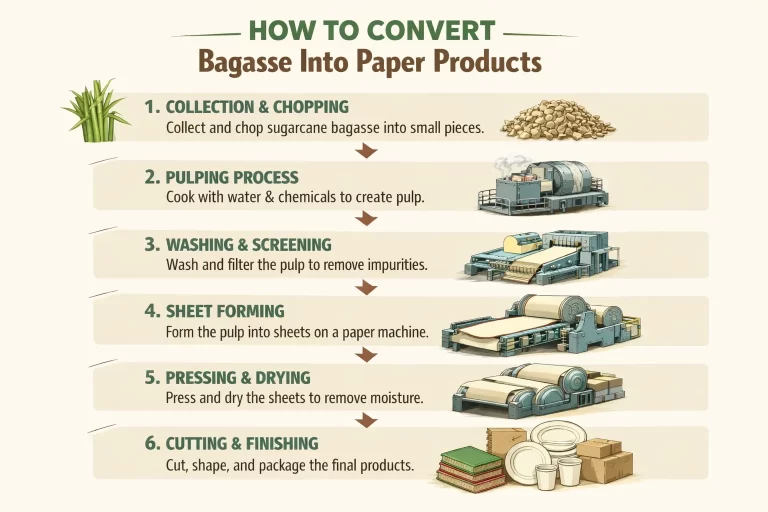
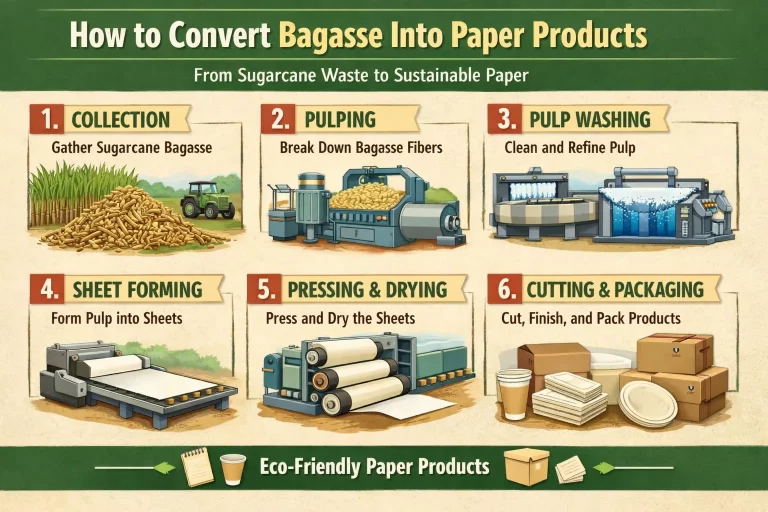
Step-by-Step Process to Convert Bagasse Into Paper Products
Step 1: Collection of Bagasse
Bagasse is collected from sugar mills after sugarcane juice extraction.
At this stage:
- It contains moisture and impurities
- It is stored and transported for processing
Proper storage is important to prevent degradation.
Step 2: Cleaning and Preparation
Raw bagasse is cleaned to remove:
- Dirt and sand
- Residual sugar
- Unwanted particles
This step ensures the material is suitable for pulp production.
Step 3: Pulping Process
The cleaned bagasse is converted into pulp using mechanical or chemical methods.
Key steps include:
- Breaking down fibers
- Mixing with water
- Separating usable cellulose
The result is a uniform pulp used for paper manufacturing.
Step 4: Bleaching (Optional)
Bleaching is used to improve the color and brightness of paper.
Eco friendly processes use:
- Oxygen-based bleaching
- Chlorine-free methods
This step depends on the type of paper being produced.
Step 5: Sheet Formation
The pulp is spread onto screens to form paper sheets.
During this stage:
- Water is drained
- Fibers bond together
- Sheet thickness is controlled
This determines the final quality of the paper.
Step 6: Pressing and Drying
The sheets are pressed to remove excess water and then dried using heat.
This step ensures:
- Strength and durability
- Smooth surface finish
- Proper moisture balance
Step 7: Finishing and Cutting
The dried paper is processed into final products.
This includes:
- Cutting into sheets or rolls
- Surface finishing
- Packaging
Types of Paper Products Made from Bagasse
Bagasse pulp can be used to produce various paper products.
Writing and Printing Paper
Used for notebooks, office paper, and books.
Packaging Paper
Used for:
- Food packaging
- Paper bags
- Cartons
Tissue and Hygiene Products
Bagasse is also used for:
- Tissue paper
- Napkins
- Paper towels
Molded Fiber Products
Used for trays, cartons, and protective packaging.
Advantages of Bagasse Paper Products
Environmentally Friendly
Bagasse paper reduces dependence on wood and lowers environmental impact.
Renewable Resource
Bagasse is continuously produced as part of sugar manufacturing.
Biodegradable and Compostable
Paper products made from bagasse break down naturally.
Cost Efficiency
Using agricultural waste reduces raw material costs in the long term.
Applications Across Industries
Bagasse paper products are used in:
- Packaging industry
- Food service sector
- Printing and publishing
- Retail and eCommerce
- Household products
Their versatility makes them suitable for multiple applications.
Challenges in Bagasse Paper Production
While bagasse offers many benefits, some challenges exist.
- Requires proper processing infrastructure
- Seasonal availability depending on sugar production
- Initial setup cost for manufacturing units
However, these challenges are decreasing as technology improves.
What Is Bagasse?
Bagasse is the fibrous residue left after extracting juice from sugarcane during sugar production. It is widely available in sugar-producing countries and is considered a renewable agricultural by-product.
Instead of being burned or discarded, bagasse can be used to produce:
- Paper products
- Packaging materials
- Disposable tableware
- Molded fiber products
Its high cellulose content makes it suitable for paper manufacturing.
Why Use Bagasse for Paper Production?
Sustainable Alternative to Wood
Bagasse reduces the need for wood pulp, helping to minimize deforestation.
Abundant Raw Material
Countries like India produce large quantities of sugarcane, ensuring a continuous supply of bagasse.
Lower Environmental Impact
Bagasse-based paper production consumes less energy and water compared to traditional wood pulp processes.
Step-by-Step Process to Convert Bagasse Into Paper Products
Step 1: Collection of Bagasse
Bagasse is collected from sugar mills after sugarcane juice extraction.
At this stage:
- It contains moisture and impurities
- It is stored and transported for processing
Proper storage is important to prevent degradation.
Step 2: Cleaning and Preparation
Raw bagasse is cleaned to remove:
- Dirt and sand
- Residual sugar
- Unwanted particles
This step ensures the material is suitable for pulp production.
Step 3: Pulping Process
The cleaned bagasse is converted into pulp using mechanical or chemical methods.
Key steps include:
- Breaking down fibers
- Mixing with water
- Separating usable cellulose
The result is a uniform pulp used for paper manufacturing.
Step 4: Bleaching (Optional)
Bleaching is used to improve the color and brightness of paper.
Eco friendly processes use:
- Oxygen-based bleaching
- Chlorine-free methods
This step depends on the type of paper being produced.
Step 5: Sheet Formation
The pulp is spread onto screens to form paper sheets.
During this stage:
- Water is drained
- Fibers bond together
- Sheet thickness is controlled
This determines the final quality of the paper.
Step 6: Pressing and Drying
The sheets are pressed to remove excess water and then dried using heat.
This step ensures:
- Strength and durability
- Smooth surface finish
- Proper moisture balance
Step 7: Finishing and Cutting
The dried paper is processed into final products.
This includes:
- Cutting into sheets or rolls
- Surface finishing
- Packaging
Types of Paper Products Made from Bagasse
Bagasse pulp can be used to produce various paper products.
Writing and Printing Paper
Used for notebooks, office paper, and books.
Packaging Paper
Used for:
- Food packaging
- Paper bags
- Cartons
Tissue and Hygiene Products
Bagasse is also used for:
- Tissue paper
- Napkins
- Paper towels
Molded Fiber Products
Used for trays, cartons, and protective packaging.
Advantages of Bagasse Paper Products
Environmentally Friendly
Bagasse paper reduces dependence on wood and lowers environmental impact.
Renewable Resource
Bagasse is continuously produced as part of sugar manufacturing.
Biodegradable and Compostable
Paper products made from bagasse break down naturally.
Cost Efficiency
Using agricultural waste reduces raw material costs in the long term.
Applications Across Industries
Bagasse paper products are used in:
- Packaging industry
- Food service sector
- Printing and publishing
- Retail and eCommerce
- Household products
Their versatility makes them suitable for multiple applications.
Challenges in Bagasse Paper Production
While bagasse offers many benefits, some challenges exist.
- Requires proper processing infrastructure
- Seasonal availability depending on sugar production
- Initial setup cost for manufacturing units
However, these challenges are decreasing as technology improves.