
Introduction
Sustainable food packaging is becoming a practical business decision for restaurants in 2026. Takeaway orders, food delivery, catering, and grab-and-go meals have increased the need for packaging that protects food while reducing unnecessary environmental impact.
Traditional single-use plastic packaging can create waste-management challenges, while some alternative products may have limitations related to cost, durability, moisture resistance, heat tolerance, or local disposal systems. Restaurants therefore need to choose packaging based on actual use rather than simply selecting a product labeled “eco-friendly.”
The right sustainable food packaging can help restaurants reduce unnecessary plastic, improve the customer experience, meet changing packaging expectations, and build more responsible foodservice operations. Understanding the major sustainable food packaging trends in 2026 can help restaurant owners, caterers, cloud kitchens, and food delivery businesses make better purchasing decisions.
1. Bagasse and Molded Fiber Packaging
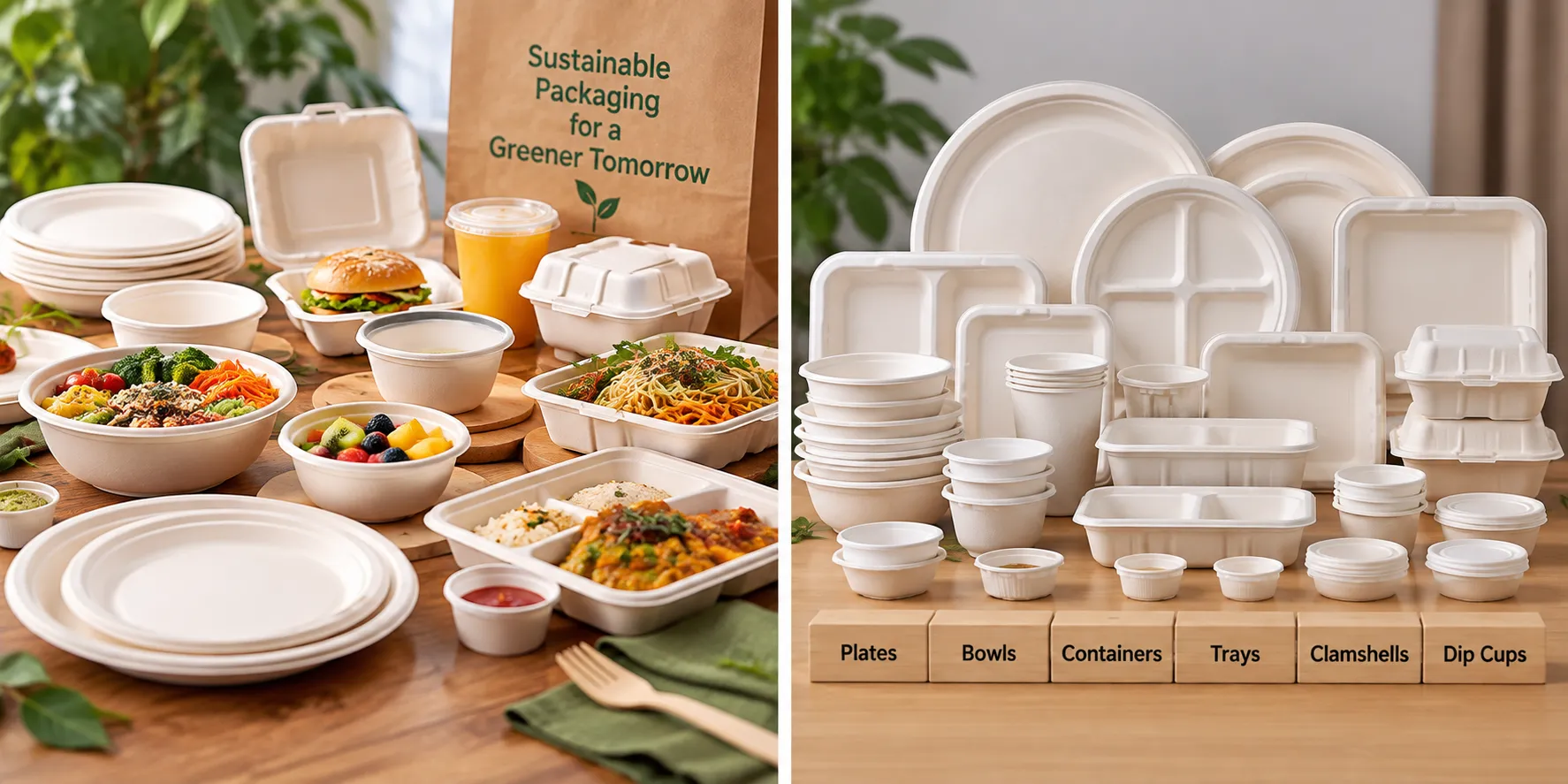
Bagasse food packaging remains one of the most important sustainable packaging options for restaurants in 2026.
Bagasse is made from the fibrous residue left after sugarcane juice extraction. This material can be processed into molded plates, bowls, trays, clamshells, and takeaway food containers.
Restaurants are interested in bagasse because it can provide a practical combination of:
- Plant-based material
- Lightweight construction
- Good rigidity
- Suitable foodservice performance
- Professional appearance
- Multiple shapes and sizes
Bagasse packaging is especially useful for takeaway meals, catering, events, institutional foodservice, and delivery applications.
However, restaurants should check the specific product’s food-contact compliance, performance characteristics, and end-of-life claims before purchasing.
2. Compostable Foodservice Packaging
Compostable packaging continues to attract attention from restaurants looking to reduce dependence on conventional plastics.
Products may include compostable plates, bowls, trays, containers, cutlery, and other foodservice items. However, the term “compostable” needs careful consideration.
A package may be designed for industrial composting rather than home composting. If suitable composting facilities aren’t available locally, the intended environmental benefit may not be achieved.
In 2026, restaurants are increasingly likely to evaluate compostable packaging alongside questions such as:
- Where can customers dispose of it?
- Is commercial composting available?
- Does the packaging have appropriate certification?
- Is the product suitable for hot and oily foods?
- What instructions should customers receive?
The best choice depends on both product performance and local waste infrastructure.
3. Paper-Based and Fiber Packaging
Paper and fiber-based packaging continue to expand across restaurant applications.
Paperboard boxes, kraft takeaway containers, paper bags, molded fiber trays, and other fiber-based formats can provide alternatives to conventional plastic packaging.
Their popularity comes from several practical advantages. They can be lightweight, printable, stackable, and suitable for branding.
Restaurants can use paper-based packaging for:
- Burgers and sandwiches
- Bakery products
- Snacks
- Takeaway meals
- Dry foods
- Catering
- Food delivery
The important consideration is the barrier system. Grease, moisture, sauces, and heat can affect paper-based packaging. Restaurants should select products designed for the specific food application instead of treating all paper packaging as interchangeable.
4. Reduced-Plastic Packaging
One of the clearest trends in sustainable restaurant packaging is plastic reduction.
Restaurants don’t necessarily need to replace every packaging component with a completely different material. Reducing unnecessary material can also make a meaningful difference.
Examples include:
- Eliminating unnecessary plastic lids
- Reducing excessive secondary packaging
- Using right-sized containers
- Replacing plastic trays with fiber alternatives
- Removing unnecessary cutlery from orders
- Using paper-based bags where appropriate
This approach focuses on using less material while maintaining food protection and customer convenience.
5. Recyclable Packaging Designed for Real Recycling
Recyclability remains important, but restaurants and packaging buyers are paying more attention to whether packaging can actually enter existing recycling systems.
A package may technically be recyclable, but food contamination, mixed materials, coatings, labels, or local collection systems can affect its real-world recyclability.
This has increased interest in packaging designs that are easier to identify, sort, and process.
Restaurants should therefore consider:
Material selection + package design + contamination + local recycling infrastructure.
Clear disposal guidance can also help customers make the correct choice.
6. Mono-Material Packaging
Mono-material packaging is another important packaging design trend.
Instead of combining multiple materials that are difficult to separate, manufacturers can design packaging using a single primary material where performance requirements allow.
This can make packaging easier to process within suitable recycling systems.
For restaurants, the benefit is particularly relevant to takeaway packaging where convenience and disposal need to work together.
However, restaurants should still verify the actual recycling pathway in their market rather than assuming that a mono-material package will automatically be recycled everywhere.
7. Lightweight Packaging
Reducing packaging weight can help lower material consumption and transportation requirements.
Lightweight packaging uses less raw material while maintaining the strength required for handling, stacking, transportation, and food protection.
Manufacturers are improving product design through:
- Better molds
- Optimized wall thickness
- Improved fiber processing
- More efficient packaging structures
- Better nesting and stacking
For restaurants purchasing large quantities, lightweight packaging can also influence storage space, shipping costs, and inventory management.
The goal isn’t simply to make packaging thinner. It needs to remain strong enough for its intended application.
8. Packaging for Food Delivery
Food delivery continues to influence restaurant packaging decisions in 2026.
Delivery packaging must withstand more than a short trip from kitchen to table. It may experience handling, vibration, temperature changes, stacking, and extended holding periods.
Restaurants therefore need packaging that helps prevent:
- Leakage
- Crushing
- Sauce spills
- Food contamination
- Loss of temperature
- Product deformation
Bagasse clamshells, molded fiber containers, paper-based boxes, and other purpose-designed formats can serve different delivery requirements.
Packaging should be tested with the actual food being sold. A container that works well for dry foods may not perform equally well with curry, gravy, or oily dishes.
9. Reusable Packaging for Selected Restaurant Models
Reusable packaging is also gaining attention, particularly in controlled foodservice environments.
Restaurants, campuses, offices, events, and delivery networks with established return systems may be able to use reusable containers effectively.
But reusable packaging isn’t automatically the best option for every restaurant. Its environmental performance depends on factors such as:
- Number of reuse cycles
- Washing requirements
- Transportation
- Return rates
- Water and energy use
- Packaging weight
- Operational logistics
For some businesses, reusable systems can make sense. For others, well-designed single-use fiber packaging may be more practical.
The key trend in 2026 is choosing the system that works best for the actual operating model.
10. Better Packaging Transparency
Restaurant customers increasingly want to understand what happens to packaging after use.
As a result, packaging communication is becoming more important.
Instead of vague claims such as “100% green,” restaurants can provide clearer information about:
- Material type
- Recyclability
- Compostability
- Disposal instructions
- Certifications
- Responsible sourcing
Clear communication supports better customer decisions and helps restaurants avoid unsupported environmental claims.
This is also important from an EEAT perspective. Sustainability claims should be specific, evidence-based, and supported by appropriate documentation.
11. Custom Sustainable Packaging for Restaurant Brands
Custom packaging is moving beyond logos and colors.
Restaurants increasingly want packaging that combines branding with practical sustainability features.
Customization can include:
- Brand printing
- Custom sizes
- Compartment designs
- Product-specific shapes
- Private-label packaging
- Custom carton configurations
For larger restaurant chains and foodservice businesses, customized packaging can improve portion control, stacking, presentation, and operational efficiency.
The best packaging design considers the entire foodservice process, from kitchen preparation to customer disposal.
How Restaurants Should Choose Sustainable Packaging in 2026
Restaurants shouldn’t select packaging based on one sustainability claim. A better approach is to evaluate the product across its full use cycle.
Consider these questions:
1. What food will it hold?
Check whether the packaging can handle the food’s temperature, moisture, oil, weight, and portion size.
2. What material is used?
Understand whether the packaging is made from bagasse, paper, molded fiber, plastic, or another material.
3. Is it food-contact compliant?
Ask suppliers for relevant test reports and documentation for the intended market.
4. What happens after use?
Check whether the product is actually recyclable or compostable within the local waste-management system.
5. Can the packaging reduce material use?
Right-sized and lightweight packaging may reduce unnecessary material without sacrificing performance.
6. Can the supplier provide consistent quality?
Restaurants need reliable supply and consistent dimensions across repeated orders.
7. What is the total cost?
Compare product price, packaging, storage, transportation, wastage, and operational costs rather than looking only at the unit price.
Why Bagasse Packaging Is Important for Restaurants
Among the sustainable food packaging trends for 2026, bagasse is particularly relevant because it combines a plant-based raw material with practical molded foodservice formats.
Restaurants can choose from bagasse plates, bowls, trays, clamshell containers, and takeaway boxes for different applications.
For buyers, the focus should remain on verified food-contact suitability, product performance, manufacturing consistency, appropriate certifications, and realistic end-of-life options.
Why Choose Fomex Group India?
Fomex Group India provides sustainable disposable food packaging solutions for commercial buyers, including customers looking for bagasse-based products.
The company is based in Gujarat, India, and serves domestic and export markets. Buyers can discuss product specifications, sizes, packaging configurations, customization, minimum order quantities, export requirements, and documentation directly with the manufacturer.
For restaurants and foodservice distributors, evaluating samples before a large order remains an important step. Product performance should match the restaurant’s specific food, delivery method, and operating conditions.
FAQs About Sustainable Food Packaging Trends in 2026
Bagasse and molded fiber packaging are among the major trends, alongside recyclable paper-based packaging, plastic reduction, lightweight designs, and packaging designed around real recycling or composting infrastructure.
Yes. Bagasse plates, bowls, trays, and containers can be suitable for many restaurant, takeaway, catering, and food delivery applications. Restaurants should verify the specific product's food-contact compliance and performance.
Not necessarily. Its environmental benefit depends partly on whether appropriate composting infrastructure is available. Restaurants should evaluate material, product performance, certification, and local disposal options together.
Consider food compatibility, material, strength, temperature resistance, food-contact compliance, disposal options, supplier reliability, packaging efficiency, and total cost.
It depends on the specific product, manufacturing process, coatings, use case, and end-of-life system. Restaurants should compare complete packaging systems rather than assuming one material is always better.
Some sustainable packaging products can have higher unit costs than conventional alternatives. However, total cost should also consider material reduction, shipping, storage, wastage, customer expectations, and regulatory requirements.
Conclusion
The sustainable food packaging trends of 2026 are moving toward practical solutions rather than simple “eco-friendly” labels. Bagasse and molded fiber, recyclable paper, compostable products, plastic reduction, lightweight designs, mono-material formats, reusable systems, and better disposal communication all have a role to play.
For restaurants, the best packaging choice depends on the food, operating model, budget, customer expectations, and local waste infrastructure.
The most reliable approach is to evaluate packaging based on performance, food safety, evidence-backed sustainability claims, supply reliability, and real-world end-of-life options. By taking this approach, restaurants can make more informed packaging decisions while reducing unnecessary environmental impact.