
To choose a reliable bagasse tableware manufacturer in India for export, check product quality, food-contact compliance, manufacturing capacity, certifications, customization options, export experience, packaging standards, pricing, lead times, and after-sales support. A dependable manufacturer should provide consistent quality across bulk orders and the documentation required for international markets.
Introduction
Answer: Choosing the right bagasse tableware manufacturer in India is important for importers, distributors, wholesalers, foodservice companies, and private-label brands. India has become an important sourcing market for eco-friendly disposable food packaging because bagasse products offer a practical alternative to conventional plastic and foam tableware.
Problem: Finding a supplier is easy. Finding a manufacturer that can consistently deliver the right quality, quantity, specifications, and export documentation is more difficult. A low initial price may not be beneficial if products arrive damaged, vary between batches, fail buyer requirements, or face customs and compliance issues.
Promise: A reliable sourcing process should evaluate the manufacturer before placing a large order. By checking manufacturing capabilities, product specifications, food-contact requirements, quality control, certifications, packaging, and export experience, buyers can reduce supply risks and build a dependable long-term relationship.
What Is Bagasse Tableware?
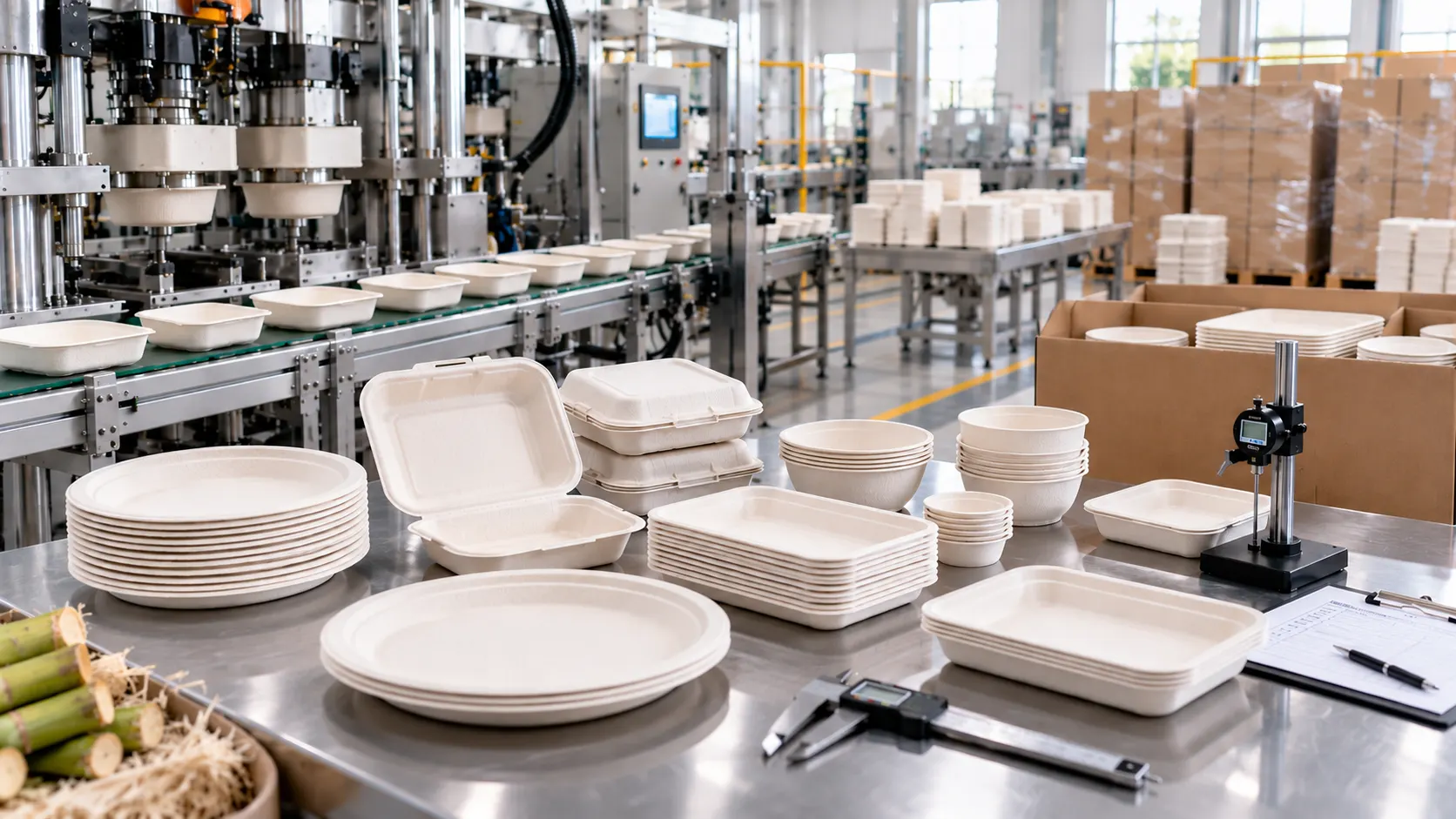
Bagasse tableware is disposable foodservice ware made primarily from sugarcane bagasse, the fibrous material left after sugarcane juice extraction. Manufacturers process the fiber into pulp, form it under controlled conditions, and manufacture products such as plates, bowls, trays, containers, and clamshell boxes.
Compared with many traditional disposable products, bagasse tableware is valued for its plant-based raw material and suitability for foodservice applications. It is commonly used by restaurants, catering businesses, takeaway services, institutional kitchens, events, and food delivery companies.
For exporters, however, the raw material alone doesn’t determine product quality. Manufacturing controls, molding quality, moisture management, food-contact compliance, and packaging all influence whether a supplier is suitable for international distribution.
1. Check the Manufacturer’s Product Range
Start by reviewing the manufacturer’s complete product portfolio.
A capable bagasse tableware manufacturer may offer:
- Bagasse plates
- Bagasse bowls
- Bagasse trays
- Bagasse food containers
- Bagasse clamshell containers
- Meal trays
- Compartment plates
- Takeaway packaging
- Custom molded foodservice products
A broad product range can be useful when you want to consolidate purchasing with one supplier. More importantly, examine whether the manufacturer produces the products in-house rather than simply trading products sourced from other factories.
Ask for product specifications, dimensions, weight, capacity, material composition, packaging quantity, and available sizes before comparing quotations.
2. Verify Manufacturing Capacity
Export buyers need more than attractive samples. They need reliable production at commercial scale.
Ask the manufacturer about:
- Monthly production capacity
- Number of production lines
- Manufacturing facilities
- Machinery and molding technology
- Production lead time
- Workforce and quality-control teams
- Raw material sourcing
- Ability to handle repeat orders
Capacity should match your expected order volume. A supplier that can produce a few sample cartons may not be suitable for recurring container-scale exports.
Also ask whether the manufacturer can maintain the same specifications across repeat production. Consistency is particularly important for distributors and private-label buyers because customers expect every shipment to match previous orders.
3. Evaluate Product Quality Carefully
Product quality should be assessed using samples rather than photographs alone.
When reviewing bagasse plates, bowls, or containers, check:
- Surface smoothness
- Shape and dimensions
- Wall thickness
- Structural strength
- Edge finishing
- Moisture resistance
- Resistance to hot and cold food
- Resistance to oils and sauces
- Stacking performance
- Odor and appearance
- Packaging condition
For food containers, also check whether lids fit properly and remain secure during handling.
A professional manufacturer should be able to explain its quality-control process and product specifications instead of simply saying that its products are “premium quality.”
4. Ask About Food-Contact Compliance
For export markets, food-contact safety is a critical purchasing consideration.
Different countries and regions can have different requirements for materials that come into contact with food. Depending on the destination market, buyers may need relevant declarations, test reports, certificates, or compliance documentation.
Before ordering, ask the manufacturer:
- What food-contact standards does the product meet?
- Are independent laboratory test reports available?
- What materials and additives are used?
- Can documentation be provided for the target market?
- Are compliance documents available for each relevant product or material?
Don’t assume that a general factory certificate proves that every product meets every destination country’s requirements. Match documentation to the specific product and target market.
5. Review Certifications and Test Reports
Certifications can help verify a manufacturer’s quality and management systems, but buyers should examine what each document actually covers.
Depending on the manufacturer and destination market, relevant documentation may include quality-management certifications, food-contact testing, environmental certifications, product test reports, or other market-specific documents.
Check:
- Certificate name
- Issuing organization
- Certificate number
- Validity period
- Scope
- Applicable products
- Manufacturing location
If a supplier provides test reports, verify that the report relates to the actual product or material you intend to purchase.
This is an important part of EEAT-focused sourcing, because credible claims should be supported by verifiable evidence rather than marketing language.
6. Confirm Export Experience
A manufacturer experienced in international shipments is generally better prepared for the practical requirements of export orders.
Ask about the countries and regions they currently serve and whether they regularly work with:
- Importers
- Distributors
- Foodservice companies
- Restaurant chains
- Supermarket suppliers
- Private-label brands
- Catering suppliers
Export experience can indicate familiarity with commercial documentation, carton marking, packing requirements, container loading, shipping schedules, and buyer communication.
However, don’t choose a supplier solely because it claims to export. Ask for evidence of experience and confirm whether its processes match your market requirements.
7. Check Packaging and Container Loading
Packaging is often overlooked during supplier selection, but poor packaging can cause significant losses during international transportation.
Ask how the products are packed for export. Check:
- Inner packaging
- Master carton strength
- Carton dimensions
- Product quantity per carton
- Moisture protection
- Palletization, if required
- Carton labeling
- Container loading method
- Maximum stacking considerations
For lightweight molded fiber products, efficient carton design can also affect freight costs. A manufacturer that understands export packing can help maximize container utilization while protecting products from compression and moisture.
8. Compare Pricing Beyond the Unit Cost
Price matters, but the cheapest quotation isn’t necessarily the best deal.
When comparing bagasse tableware suppliers in India, consider the total landed cost, including:
Product price + packaging + inland transportation + export charges + freight + insurance + customs and destination costs.
Also clarify the quotation basis. Depending on the transaction, prices may be quoted using terms such as EXW, FOB, CIF, or other Incoterms.
Ask about:
- Minimum order quantity
- Sample charges
- Tooling costs
- Printing or private-label costs
- Packaging costs
- Payment terms
- Production lead time
- Price validity
- Replacement policy for defective goods
A transparent quotation makes supplier comparison much easier.
9. Assess Customization and Private-Label Capability
If you’re building a brand, customization can be an important selection factor.
Ask whether the manufacturer can support:
- Custom product dimensions
- Compartments
- Special shapes
- Embossing
- Custom packaging
- Private labeling
- Printed cartons
- Product-specific packing configurations
Before approving customized production, confirm the tooling process, mold ownership, development costs, sample approval process, and production timeline.
A reliable manufacturer should provide a clear approval process before mass production begins.
10. Test Communication and Order Management
Communication is a practical indicator of how easy a supplier will be to work with.
During the quotation and sampling stage, evaluate whether the manufacturer answers questions clearly and provides complete information.
Look for a supplier that can clearly communicate:
- Product specifications
- Production timelines
- Order quantities
- Packaging details
- Documentation
- Shipping information
- Quality procedures
- Payment conditions
Pay attention to how the supplier handles problems. If communication becomes difficult before an order is placed, managing a large international shipment may become even harder.
11. Start With Samples and a Trial Order
Don’t move directly from a quotation to a large purchase order.
First request samples and evaluate them against your requirements. If possible, conduct product testing appropriate to your intended application and market.
After sample approval, consider starting with a manageable commercial order before moving into long-term high-volume purchasing.
A trial order allows you to evaluate:
- Product consistency
- Packaging quality
- Production accuracy
- Order fulfillment
- Documentation
- Shipping coordination
- Communication
- Response to quality issues
This gives you practical evidence of supplier performance.
Why Choose an Indian Bagasse Tableware Manufacturer?
India offers several advantages for buyers sourcing sugarcane bagasse tableware. The country has a large agricultural and sugar-processing sector, an established manufacturing base, and growing capabilities in molded fiber food packaging.
For international buyers, working directly with a manufacturer can also provide better control over product specifications, packaging, customization, and bulk purchasing.
The key is to select the right manufacturer, not simply the supplier offering the lowest price.
Why Choose Fomex Group India?
Fomex Group India supplies disposable and sustainable food packaging solutions for commercial buyers. Based in Gujarat, the company serves domestic and export customers looking for bagasse-based foodservice products.
For buyers evaluating Fomex, the important areas to discuss directly with the company include product specifications, available sizes, minimum order quantities, customization, packaging, export documentation, lead times, and destination-market requirements.
As with any international supplier, buyers should review samples and applicable documentation before confirming a large order.
Export Buyer Checklist
Before selecting a bagasse tableware manufacturer in India, use this checklist:
- Manufacturer produces the required products
- Production capacity matches your order volume
- Samples meet your quality requirements
- Product specifications are clearly documented
- Food-contact documentation is available where required
- Relevant certifications and test reports can be verified
- Export experience is demonstrated
- Export packaging is suitable
- MOQ is commercially practical
- Pricing and Incoterms are clear
- Customization is available if required
- Lead times are realistic
- Communication is reliable
- Defect and replacement procedures are defined
- Trial order performance is satisfactory
Final Thoughts
Choosing a reliable bagasse tableware manufacturer in India for export requires more than comparing prices. Product quality, manufacturing capacity, food-contact compliance, certifications, export experience, packaging, customization, communication, and order consistency should all be evaluated before making a long-term commitment.
The safest approach is simple: verify the manufacturer, test the products, check the documentation, place a controlled trial order, and evaluate the supplier’s actual performance before scaling up.
For importers, wholesalers, distributors, foodservice businesses, and private-label brands, this process can help identify a bagasse tableware supplier that is capable of supporting consistent international orders while meeting the quality and documentation requirements of the target market.
Frequently Asked Questions
Check manufacturing capacity, product quality, food-contact compliance, certifications, export experience, packaging, pricing, customization, lead times, and customer support. Always request samples and verify documentation before placing a large order.
Common products include bagasse plates, bowls, trays, compartment plates, food containers, clamshells, and takeaway packaging. Product availability varies by manufacturer.
Yes. Bagasse tableware is widely used for serving and takeaway applications. Buyers should confirm the specific product's food-contact suitability, performance characteristics, and applicable market requirements.
Ask for certifications and test reports relevant to the product and destination market. Check their scope, validity, issuing organization, and whether they apply to the actual products being purchased.
Yes. Samples allow you to evaluate dimensions, strength, finishing, packaging, and product performance before committing to a larger export order.
Compare product Some manufacturers offer private-label and customized products, including packaging and product configurations. Confirm tooling, minimum quantities, artwork requirements, costs, and production timelines before approval.
India has established sugarcane and manufacturing industries, along with growing production capabilities for molded fiber food packaging. Buyers should still evaluate individual manufacturers based on quality, compliance, capacity, and export performance.